
Can You Be Underweight and Still Have an Eating Disorder?
If you’ve been wondering whether something is wrong but keep telling yourself you’re fine, this page is for you.
There’s a question I hear in my therapy room more often than you might expect.
Not from clients who are deeply unwell and know it, but from people who are quietly struggling and genuinely unsure whether what they’re experiencing counts.
“I know I’m on the lighter side,” they’ll say. “But I eat. I’m functioning. Does this actually qualify as an eating disorder?”
The honest answer is: yes. It very possibly does.
Being underweight doesn’t automatically mean you have an eating disorder. But being underweight alongside a difficult relationship with food, a preoccupation with what you eat, or deep anxiety about your body – that combination matters. And far too many people sit with that combination for years, telling themselves they’re fine because the number on the scale isn’t alarming enough to warrant concern.
This page is for anyone who has ever wondered whether something was wrong but talked themselves out of believing it.
What Being Underweight Actually Does to Your Body
The scale gives you a number. What it doesn’t give you is a picture of what’s happening inside.
When the body doesn’t receive enough energy consistently, it adapts. Not in a good way. It begins to prioritise survival over everything else, which means pulling resources away from systems it judges as non-essential. Bones lose density, sometimes as early as your twenties. Hormones shift in ways that disrupt mood, concentration, and the menstrual cycle. The cardiovascular system comes under strain. The brain, which depends on a steady supply of energy, begins to struggle, which affects memory, decision-making, and emotional regulation.
These changes can happen at a weight that looks, from the outside, like everything is perfectly fine.
The body masks a lot. The eating disorder masks even more. The warning signs get missed (by healthcare professionals, by families, and by the person themselves) because someone appears physically functional, and may even be receiving compliments for how they look.
Some of the physical consequences that can develop when the body is chronically under-nourished include brittle bones, disrupted hormones, poor circulation, cardiovascular changes, persistent fatigue that sleep doesn’t fix, difficulty concentrating, and hair thinning or loss. None of these are inevitable, and recovery is genuinely possible. The body has a remarkable capacity to heal. But the longer these changes go unaddressed, the harder some of them become to reverse which is why early support matters so much.
If someone is significantly underweight or medically compromised, therapy should sit alongside appropriate medical monitoring through a GP or specialist eating disorder service where needed.
Why So Many People Don't Realise Their Weight Is a Problem
This is the part that doesn’t get spoken about enough.
Eating disorders are persistent in the way they distort perception. One of the most consistent things I hear from clients is that they genuinely could not see what was happening. They knew the numbers. They could see them on the scale. But the internal voice was so loud, so convincing – the one that said “you’re fine, you don’t qualify, you’re not that bad, you don’t need help” – that the evidence stopped registering as serious.
This is not weakness. It is not vanity or stubbornness. It is what eating disorders do. They are extraordinarily good at defending themselves.
There are cultural factors at play too. We live in a society that rewards thinness and, in many contexts, celebrates it. People who are slim often receive compliments. They get told they look well. Their body is treated as an achievement. So when someone who is genuinely under-nourished hears “you look amazing,” the eating disorder feeds on it. That validation becomes part of the reason it stays hidden.
And then there is the medical system. BMI has historically been used as a gatekeeping tool for eating disorder diagnosis and treatment. If someone didn’t meet a particular threshold, they were sometimes told they didn’t qualify for support. That approach has been deeply harmful. It has left people without help they urgently needed, and it has reinforced the belief that unless you are visibly and dramatically unwell, you don’t deserve care.
Equally, many people experience atypical anorexia, where the full psychological profile of anorexia is present without someone appearing underweight. According to Beat, the UK’s leading eating disorder charity, most people living with an eating disorder are not underweight, yet weight-based gatekeeping has meant many of them have been turned away from support for years.
That belief is wrong.
You do not need to meet a clinical threshold to deserve support. You do not need to be in crisis, or admitted to hospital, or visibly deteriorating. If your relationship with food is causing you distress, disrupting your daily life, or affecting your health, that is enough.

Why the Number on the Scale Tells You Almost Nothing
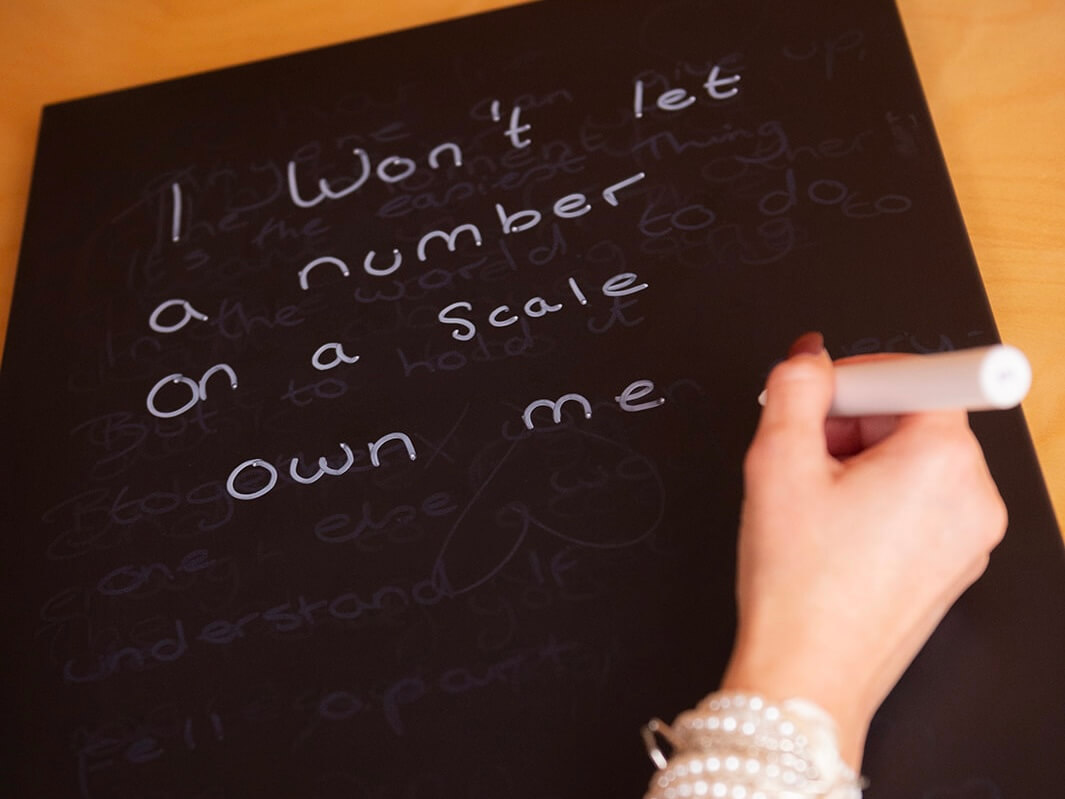
The scale measures one thing: the total mass of your body at a particular moment. That’s it.
It does not measure your bone density, your muscle mass, your organ health, or your hydration levels. It does not measure whether you are restricting, avoiding food groups, using exercise to compensate, or bingeing. It does not measure fear, or guilt, or the amount of mental energy you spend thinking about what you’ve eaten. It does not measure your relationship with your body.
Two people can stand on the same scale and get the same reading. One of them might be thriving. The other might be in the grip of a serious eating disorder. The scale cannot tell the difference.
I am not categorically opposed to weighing in every context. There are specific medical situations where monitoring weight is a useful part of care. But in the context of deciding whether something is wrong, whether the way you’re relating to food and your body is healthy or not, the scale is almost always the wrong tool. It reduces a complex, deeply personal experience to a single data point, and then invites the brain to make enormous meaning out of it.
The questions that matter far more are these: Is eating a source of anxiety for you? Do you have rigid rules around food that feel impossible to break? Are you using exercise to compensate for eating? Do you spend a significant part of your day thinking about food, your body, or your weight? Do you hide your eating habits from people who care about you?
If any of those questions made something tighten in your chest, keep reading.
Signs That Being Underweight May Be Connected to an Eating Disorder
Constant food preoccupation
Thinking about food (what you’ve eaten, what you’ll eat, what you shouldn’t have had) takes up a large and disproportionate part of your day. It crowds out other thoughts. It feels impossible to switch off.
Food rules that can't be broken
Rigid rules around eating that feel non-negotiable, even when breaking them would be perfectly safe. The anxiety that arrives when those rules are challenged is out of proportion to the situation.
Avoiding eating with others
Finding reasons not to eat in social situations, eating beforehand so you don’t have to at the event, or feeling intense anxiety when food is involved with other people.
Exercise that feels compulsive
Movement that feels driven by guilt or obligation rather than enjoyment. The need to exercise to “undo” eating, or significant distress when exercise isn’t possible.
A body image that doesn't match reality
Seeing a body in the mirror that doesn’t match what others describe. Feeling larger than you are, or feeling unable to trust your own perception of your size.
Secrecy around food
Hiding what or how much you eat. Feeling ashamed of your eating habits, whether that’s shame around eating too little, too much, or in particular ways. The secrecy itself is often the clearest signal.

A Note From Becky
A Note From Me
I’ve worked with people who came to me as a last resort, people who had been turned away from other services because their weight wasn’t considered low enough. I’ve also worked with people who didn’t believe they qualified for support at all, who had convinced themselves they were just disciplined, or just naturally slim, or just careful about what they ate.
What strikes me, every time, is how long they had been carrying something alone that they deserved support with years earlier.
If you’re reading this and recognising something in what I’ve described, either in yourself or in someone you love, I want to be clear: you do not need to hit a particular number to ask for help. You do not need to be visibly unwell. You need to be struggling. And that is enough.
I work with adults and young people in Canterbury and online across the UK. I specialise in eating disorders, disordered eating, and difficult relationships with the body and food. The first conversation is always free.
What Recovery From an Eating Disorder Actually Looks Like
Recovery is not a straight line, and I won’t pretend otherwise. But it is possible. Genuinely, sustainably possible not just keeping the eating disorder quiet, but rebuilding a relationship with food and your body that feels liveable, and eventually, good.
In the work I do, recovery typically involves several interconnected threads. Understanding what the eating disorder has been doing for you psychologically because there is always a reason it developed, even if that reason is now causing more harm than it prevents. Unpacking the beliefs that sit underneath it, about worth, about control, about safety. Gradually, carefully, beginning to challenge the rules and the fear at a pace the nervous system can manage.
This is why therapy that treats the whole person matters so much. Addressing the number without addressing the thought patterns and emotional drivers underneath tends not to hold. Real recovery happens when the psychological roots are worked through alongside the practical changes.
The work is not always easy. But it does not have to last forever, and you do not have to do it alone. Find out more about eating disorder therapy.
Your Questions Answered
Can you have an eating disorder if you are not underweight?
Absolutely, yes. Eating disorders exist across the full range of body sizes, and most people living with an eating disorder are not underweight. Disorders like bulimia nervosa, binge eating disorder, and atypical anorexia often present in people whose weight falls within what is considered a normal or higher range. Weight is not a reliable indicator of whether an eating disorder is present or how serious it is.
What is the difference between being naturally slim and having an eating disorder?
The key difference is psychological. Someone who is naturally slim and has no eating disorder typically has a relaxed relationship with food — they eat when they are hungry, they don’t experience significant anxiety around food choices, and their sense of self-worth is not tied to what they eat or how their body looks. An eating disorder, by contrast, involves a range of psychological patterns: rigid food rules, preoccupation with eating and weight, fear of certain foods, compensatory behaviours, and a distorted or fear-laden relationship with the body. If food and weight occupy a disproportionate amount of mental space, that is worth exploring.
At what point should I seek help for an eating disorder?
The moment it is causing you distress. You do not need to meet a specific clinical threshold or reach a particular point of physical deterioration before asking for support. If your relationship with food is affecting your daily life, your mood, your relationships, or your sense of self — that is enough reason to reach out. Earlier support tends to lead to better outcomes, and there is no minimum suffering required to deserve care.
Is it possible to have an eating disorder without realising it?
Yes, and this is far more common than most people realise. Eating disorders are often characterised by a degree of denial or minimisation not through deliberate dishonesty, but because the disorder itself distorts perception. People frequently describe having known “something wasn’t right” for years before identifying it as an eating disorder. Cultural messaging that normalises food restriction and thinness also makes it harder to recognise when a pattern has become harmful.
Can you recover from a long-term eating disorder?
Yes. Recovery is possible at any stage and at any age. The psychological patterns involved in a long-standing eating disorder can be more deeply entrenched, and the work may take longer, but people recover from eating disorders that have lasted many years. The brain retains a remarkable capacity to change with the right support. Recovery looks different for different people, but a life that is no longer dominated by food and body anxiety is genuinely achievable.
Do you offer eating disorder therapy in Canterbury?
Yes. I work with adults and young people in person in Canterbury, Kent, and online with clients across the UK. I specialise in eating disorders, disordered eating, body image, and related anxiety. I offer a free initial consultation, which is a relaxed, no-pressure conversation to talk through what you are experiencing and whether working together might help. Book your free consultation here.
Becky Stone, Eating Disorder Specialist
Becky Stone
07510 495791
I’m an eating disorder therapist and counsellor based in Canterbury, Kent. I specialise in supporting adults and young people with eating disorders, disordered eating, body image difficulties, and the anxiety that so often sits alongside them.
My approach is trauma-informed, relational, and practical. I work with the whole person, not just the presenting symptom, because in my experience that is the only way recovery holds.
I am also the founder of Counsellor Who Cares, a private practice built on the belief that everyone deserves access to thoughtful, compassionate support, without judgement and without needing to be in crisis first.
You Don't Have to Keep Carrying This Alone
You don’t need to know whether what you’re experiencing has a name before asking for help. If food, weight, or your body are taking up more space in your life than you want them to, that’s reason enough to start a conversation.
Whether you are certain something is wrong or just quietly wondering, the first call is free.